Electricity Prices in Europe 2025: the 27 EU Countries Compared
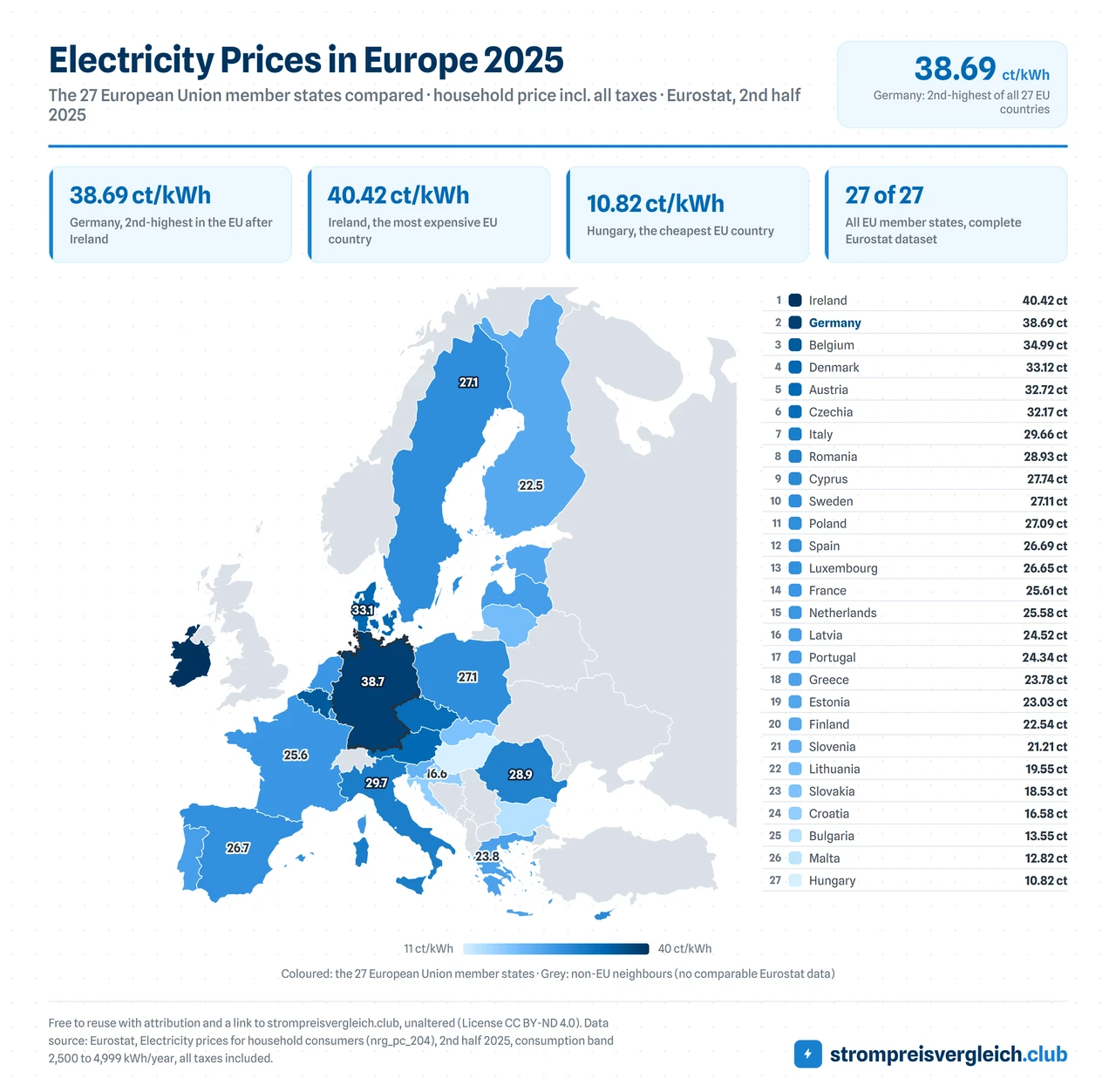
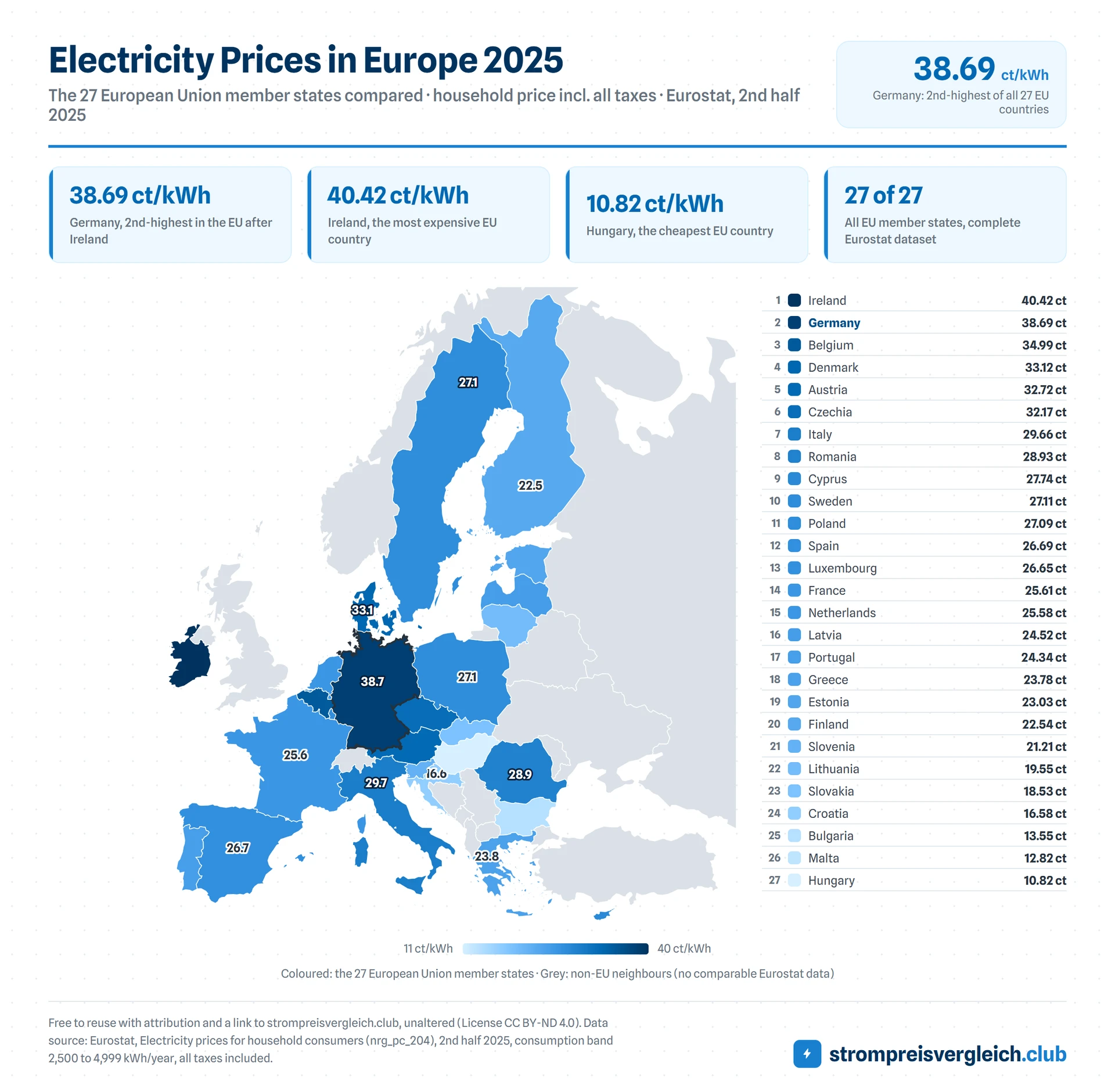
Households in Ireland pay the most for electricity in the European Union at 40.42 ct/kWh, while Hungarian consumers pay the least at 10.82 ct/kWh , a nearly fourfold difference. Germany ranks second-highest at 38.69 ct/kWh, well above the EU-27 average of 28.96 ct/kWh. All prices are for the 2nd half of 2025 and include all taxes and levies.
Key Facts at a Glance
-
40.42 ct/kWh
Ireland, most expensive EU country
-
38.69 ct/kWh
Germany, 2nd highest in the EU
-
28.96 ct/kWh
EU-27 average (all taxes incl.)
-
10.82 ct/kWh
Hungary, cheapest EU country
Source: Eurostat nrg_pc_204 · 2nd half 2025 (data update 19 May 2026) · consumption band 2,500–4,999 kWh/year
The Infographic
Free to embed with attribution · CC BY-ND 4.0 Embed this chart → close ×
Copy the HTML below and paste it into your article or website. The required attribution link is already included:
<a href="https://www.strompreisvergleich.club/electricity-prices-europe/"><img src="https://www.strompreisvergleich.club/images/electricity-prices-europe/electricity-prices-europe-1280.webp" alt="Electricity Prices in Europe 2025: EU-27 country comparison" width="1280" height="1254" loading="lazy"></a> Chart: <a href="https://www.strompreisvergleich.club/electricity-prices-europe/">strompreisvergleich.club</a>
The 27 EU Member States Ranked
Household electricity price including all taxes and levies, 2nd half 2025 (data update 19 May 2026).
| Rank | Country | ct/kWh | €/kWh |
|---|---|---|---|
| 1 | Ireland | 40.42 | 0.4042 |
| 2 | Germany DE | 38.69 | 0.3869 |
| 3 | Belgium | 34.99 | 0.3499 |
| 4 | Denmark | 33.12 | 0.3312 |
| 5 | Austria | 32.72 | 0.3272 |
| 6 | Czechia | 32.17 | 0.3217 |
| 7 | Italy | 29.66 | 0.2966 |
| 8 | Romania | 28.93 | 0.2893 |
| 9 | Cyprus | 27.74 | 0.2774 |
| 10 | Sweden | 27.11 | 0.2711 |
| 11 | Poland | 27.09 | 0.2709 |
| 12 | Spain | 26.69 | 0.2669 |
| 13 | Luxembourg | 26.65 | 0.2665 |
| 14 | France | 25.61 | 0.2561 |
| 15 | Netherlands | 25.58 | 0.2558 |
| 16 | Latvia | 24.52 | 0.2452 |
| 17 | Portugal | 24.34 | 0.2434 |
| 18 | Greece | 23.78 | 0.2378 |
| 19 | Estonia | 23.03 | 0.2303 |
| 20 | Finland | 22.54 | 0.2254 |
| 21 | Slovenia | 21.21 | 0.2121 |
| 22 | Lithuania | 19.55 | 0.1955 |
| 23 | Slovakia | 18.53 | 0.1853 |
| 24 | Croatia | 16.58 | 0.1658 |
| 25 | Bulgaria | 13.55 | 0.1355 |
| 26 | Malta | 12.82 | 0.1282 |
| 27 | Hungary | 10.82 | 0.1082 |
| — | EU-27 average | 28.96 | 0.2896 |
Download the Data
All 27 country values as open data files, free to use with attribution and link to strompreisvergleich.club (CC BY-ND 4.0).
How to Cite
Citation snippet
For articles, studies and presentations:
strompreisvergleich.club (2025): Electricity Prices in the European Union 2025 [Infographic]. Retrieved from https://www.strompreisvergleich.club/electricity-prices-europe/
Frequently Asked Questions
Which EU country has the highest electricity price in 2025?
Ireland has the highest household electricity price among all 27 EU member states in the second half of 2025, at 40.42 ct/kWh including all taxes and levies. Germany ranks second at 38.69 ct/kWh. Source: Eurostat nrg_pc_204, data update 19 May 2026.
Which EU country has the cheapest electricity?
Hungary has the lowest household electricity price in the EU at 10.82 ct/kWh in the 2nd half of 2025: less than a quarter of the Irish price. This reflects regulated end-consumer tariffs and Hungary's specific energy policy framework.
How much do German households pay for electricity?
German households pay 38.69 ct/kWh, the second-highest price in the EU, just below Ireland (40.42 ct/kWh). Germany's high price is driven by grid fees, renewable energy surcharges and taxes, which together account for roughly two-thirds of the final household bill.
What is the EU-27 average electricity price?
The average household electricity price across all 27 EU member states is 28.96 ct/kWh for the 2nd half of 2025, including all taxes and levies, for the consumption band 2,500 to 4,999 kWh per year. Source: Eurostat nrg_pc_204.
Why are electricity prices so different across EU countries?
Electricity prices vary widely across the EU because the final household bill is shaped by national taxes, levies and grid fees (often 50–70 % of the total price), the domestic energy mix (nuclear, wind, gas, hydro), the structure of the retail market, and, in some countries, regulated end-consumer tariffs. Member states with large nuclear fleets or significant renewable capacity tend to have lower wholesale costs, but the final household price still depends heavily on the national tax and levy framework.